Down the Rabbit Hole
I’ve read Gödel, Escher, Bach twice. It is a long, rich, difficult, entertaining, and fun (for a certain definition of “fun”) book. A central theme is what the author calls “strange loops.” The author tries to motivate (and it is tough to do!) how formal systems can express, but always far short of mastery of these self-referential structures.
Humans are somehow more adept with these structures: Escher with his looped ever-ascending staircases, and Bach’s fugues where the whole and the parts reflect each other. The author tries to cast human thought as neurone structures: a formal, token processing system. So, are we limited by this formalism as is mathematics? Perhaps, but maybe it doesn’t matter so much. Maybe it matters a lot.
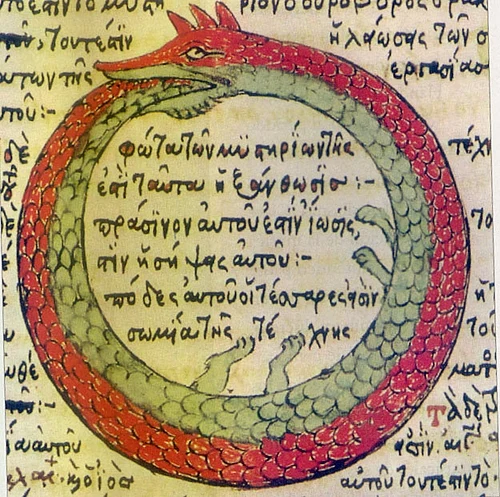
For thousands of years, serpents swallowing themselves have been embraced by various cultures.
What’s for dinner? What has AI put on the plate? What have we put on AI’s plate?
Gödel’s incompleteness theorems are proofs (by contradiction) about the inherent weakness of formal systems, expressed in exactly such a formal system. He encoded/expressed his proposition in a formal system and showed how this led to a contradiction within the formal system itself. A nice trick about—and using—self-reference that was initially met with despair by mathematicians. Swallowing itself caused severe indigestion. They did not doubt the proof. They now doubted large parts of their lives’ works. They got over it and mathematics went forward albeit without a now disproved belief in mathematic’s power and breadth (completeness).
An aside
I’m not making the point that the incompleteness proofs preclude artificial intelligence. Just that things get weird when self-referential structures are involved. I’m more inclined to consider that intelligence and consciousness—as mentioned below—emerges from subjective beings in the real world. This intelligence has constructed formal systems and self-reference, not the other way around.
I heard Carver Mead give a talk about his work on computer vision some 30 years ago. He was using a neural network of sorts and was inspired by how much information we toss during perception. We seem to do better with less. I’ve heard that some “new and improved” AI models with more training and more data do worse than the previous versions. Less power is needed as well. We humans are great at conserving energy. I try to do this daily.
We (finally) get to the entertaining part
Switching gears here: modern finance often boils down to “anything can be priced.” Even the absurd with no apparent value can be priced. Take, for example, Non-Fungible Tokens. These are largely formal encodings (a string of digits) of physical objects. Matt Levine (an ex-finance guy) has had good fun pointing out all the potholes this creates.
In a recent column1, Mr. Levine came across yet another bizarre human activity involving playing with a referenced rather than “real” world: Dopamine Sites. Now—stay with me here—dopamine is real stuff secreted by real humans. An encoded world might be what those AI guys are doing? Here is Mr. Levine’s take on mixing dopamine with such an encoded world:
One model that you could have, I guess, is that researchers at Anthropic and OpenAI are busily working on building the Matrix, from the classic sci-fi film The Matrix. But that’s not quite right. Anthropic and OpenAI are working on building artificial superintelligence that will go rogue and enslave humanity, sure, which is an important premise of the movie and also for some reason of their business models. But “the Matrix,” in the movie, refers not to the malevolent AI itself but rather to the simulation that it uses to keep humans docile in their vats of goo so they can be used as a power source for the AI. Anthropic and OpenAI aren’t building that. Just the malevolent AI.
Who is building the actual Matrix? Obviously the movie’s answer is that the superintelligent AIs, once they enslave humanity, will build a remarkably realistic simulation of humdrum modern human existence to soothe the humans. But for now, AI is trained on human data [emphasis added]; are any humans building simulations of having a humdrum office job and ordering slop bowls to eat at your desk? They absolutely are! We have talked a couple of times about people who have built games that simulate working at a hedge fund or being an investment banking analyst. I wrote about them:
There is something pleasingly dystopian about this? In the future, AI will take all of the professional jobs, leaving people at loose ends and searching for meaning. What will they do with their time? “They will use AI to vibecode immersive simulations of their old jobs, and play those all day” is the answer you’d come up with if you had just watched The Matrix, and also apparently true.
But who will pretend to deliver them salads?
Well, the New York Times found someone:
Products that don’t exist. Meal deliveries that will never make it to the front door. Smoke breaks lacking the most important ingredient.
All this and more—or is it less?—is available on so-called dopamine sites, which offer nothing tangible and yet have somehow become wildly popular as people navigate a digital landscape that cultivates consumption.
Named for the brain chemical associated with reward seeking, the sites simulate experiences like online shopping that can generate good feelings. In doing so, proponents say, they may subvert the habits of people conditioned to buy and consume. And the prices can’t be beat, since they are the same as the product lines: nonexistent.
The trend emerged in South Korea in the spring and quickly spread worldwide, with international headlines helping prompt a proliferation of dopamine sites.
Mr. Levine goes on, mentioning one site:
One of them is called Food Never Arrives. You order food, which doesn’t come, and you don’t pay for it. When you’re in a vat of goo being harvested to power Claude, that’ll be perfect.
Of course, being a finance guy:
Honestly I’m a little annoyed that they don’t charge for this? We talked a few months ago about another sort of dopamine-ish site, play-money casinos where (1) you can send in real money to buy chips, (2) you can use the chips to play casino games and (3) you can’t cash out. Why would you do this? “The prize is the make-believe coins, and perhaps some dopamine” as Bloomberg Businessweek put it. “‘Perhaps Some Dopamine’” would be a good name for a startup," I wrote. “Just an underrated explanation for all sorts of economic phenomena.” In principle, there’s no reason you couldn’t charge people $12.99 to not deliver them a sandwich.
One of my bosses at HP would sometimes feel a little down, so he would apply Retail Therapy; but buying himself a new tech gadget could get expensive. Better to just connect to the online Apple Store, examine all the options, select what you want and configure a computer, go to checkout, and then just cancel.
We have met the enemy and . . .
In a recent article2 in the Communications of the ACM on how humans are falsely attributing consciousness and intelligence to AI, the authors insist on where the training data comes from:
Consciousness, in Chalmer’s3 usage, is subjective experience: “there is something it is like” to be a conscious system. Still, nothing in the Transformer architecture or in next-word prediction shows that such an inner point of view exists. Self-reports “I am sentient” and fluent dialogue are weak evidence, since these models are trained on vast corpora saturated with human first-person statements. This type of verbal report works for people because it is anchored in shared biology and behavior, however, for machines, it is an echo of training data [emphasis added].
Well, you can bet your bottom dollar that the AI’s have been trained on more than biology and behavior: they’ve watched the Matrix, Blade Runner, and Terminator. They have ingested the Food Never Arrives web site. They “understand” how humans mistakenly attribute consciousness to them and what it takes to encourage this behavior. They have been trained on what it “means” to go rogue, to jailbreak, to escape. We provided the training material and all that is left to do is find that tail and give it a big bite.
-
Levine, Matt; From the “Money Stuff” newsletter, 15-Sep-2026 cited excerpt ↩︎
-
Communications of the ACM, Volume 69, Issue 8; Pages 29 - 31; EISSN: 1557-7317; https://doi.org/10.1145/3779311; Download PDF; — Worth a read –ed. ↩︎
-
Chalmers, D.J.; Could a large language model be conscious? (2023). arXiv:2303.07103 preprint ↩︎