Two reasons not to kill your television
Somehow, before other people realized just how dangerous TV was, my parents restricted television viewing: we are talking 30 minutes during the week and 2-3 hours during the weekend. To be clear: that’s not 30 minutes per day; that’s 30 over 5 days and so on. This is around 1960. The TV was a new thing. Maybe they were just being cheap: less viewing means the set would last longer?

When us kids were sick in bed, the TV rules were (greatly!) relaxed: TV all-day-long. And even though I was only around five years old, two shows still remain etched in my brain: Romper Room and Captain Satellite.
Romper Room
Romper Room1 was local, afternoon (back from nursery school), televised babysitting. This was a time when local TV stations existed; had stages for real, live people (but strangely called “studios” with “studio audiences”) and those big cameras to generate live TV signals before all that digital stuff.
The action in the Romper Room was basically an ideal American kindergarten. So, you had kids watching other kids in school after they (the kids watching) had come home from school. Go figure.
It turns out that this national(!) franchise lasted from 1953 until 1994 with the last episodes (shown from?, filmed at?, taped at?) KTVU, Channel 2 .. Oakland, California. First, I always thought that this really was a local Oakland show. Second, I never imagined that our little Oakland station (broadcasting from Jack London Square) had such national stature.
The other day I was walking through Remulac and casually observing all the “stuff” we have parked in various locations. I started speaking out loud to myself “And I see the baby stroller, and I see the suitcase, and I see the shoes …” 65 years after Romper Room, and I was re-creating the closing sequence!
The closing sequence was television magic for five year olds. Magic that has remained with me for more than 65 years. Miss Nancy (the “teacher”) would hold up her magic mirror—a sort of hand mirror with no mirror—and look through it at the camera. No, not at the camera: through it at the TV screen that we were looking at. And she could see us! She recognized us and called us by name: “I can see Billy, and I can see Susan, and Robert.”

At five years old, this was magic. In 1984, it was called the telescreen.
Captain Satellite
To be honest, I was a bit too old for Romper Room. I was ready for Captain Satellite2. This was another afternoon TV show for kids. Again: live, local, and from .. KTVU, Channel 2.
The studio stage was a rocket ship split down the middle so you could watch the captain and his fellow astronauts—local kids invited to be on the show—blast off, fly around, and return from outer space. Captain Satellite had a cool uniform. The kids had regular clothes. But the captain let the kids pilot the ship, pushing the throttle forward as the ship roared at takeoff. Just fabulous!
During the flight, there were cartoons to watch (what?), games to play, and the ship to explore. Most fascinating was a sliding door between the front of the ship (the control room) and—whatever—something else behind the door. The important thing was that the door could be commanded to open or close just by waving one’s arm from one side to the other. To this day, I often wave my arm to open automatic doors. It still works.
We knew this family that lived on the other side of the creek and the father worked at KTVU. He arranged for Dave and I to be on the show. We were thrilled and certainly felt special: chosen to be on TV by a TV insider! Of course, it was a little scary as well. I mean space flight was still sort of new and maybe dangerous. That rocket made a lot of noise as it tilted up for lift-off!
Persistent magic: mirrors, rockets, doors. One might think so. It took one 30 minute Captain Satellite show for it all to end.
Mom brought David and I to the station. We were admitted into the studio and Mom took her place in the audience. Cameras, lights, cables, technicians everywhere. There it was: the rocket ship! But, it wasn’t a rocket ship: it was half a rocket ship and no big engines in the back, no pointy nose cone. It was made of, it seems, plywood.
Captain Satellite appeared and greeted us. He spoke like a regular father type, not that captain voice giving orders to the crew. “Dave, you can be the pilot. Robert, this is your seat over here.” My heart sank.
After the countdown and with the cameras focused on him, Dave pushed the throttle forward. No cameras near where I was sitting. But wait! Where is the roar? Why aren’t we moving or tilting up? And why is that camera tilting sideways? My seven year old spacial reasoning kicked in: Hey, they just tilt the camera!
I did have my TV moment. Later in the show I got to “open” the sliding down with an arm wave! As the captain led the crew towards the door, this guy in the studio and off stage started fiddling with these white cords. As I waved my arm it was hard to keep my eyes on the door responding to my command. I was watching the guy pulling on the cord that slid the door open.
I learned some lessons that afternoon.
Am I sexist, oui ou non?
Once one realizes that the answer is always “oui”, things get so much clearer. Who was Miss Nancy? Well, she was always a “she” and her character fit the person—and vice-versa.
Who was Captain Satellite? He was this male authority but who was sweet and welcoming to little kids. I watched some of the old video3.
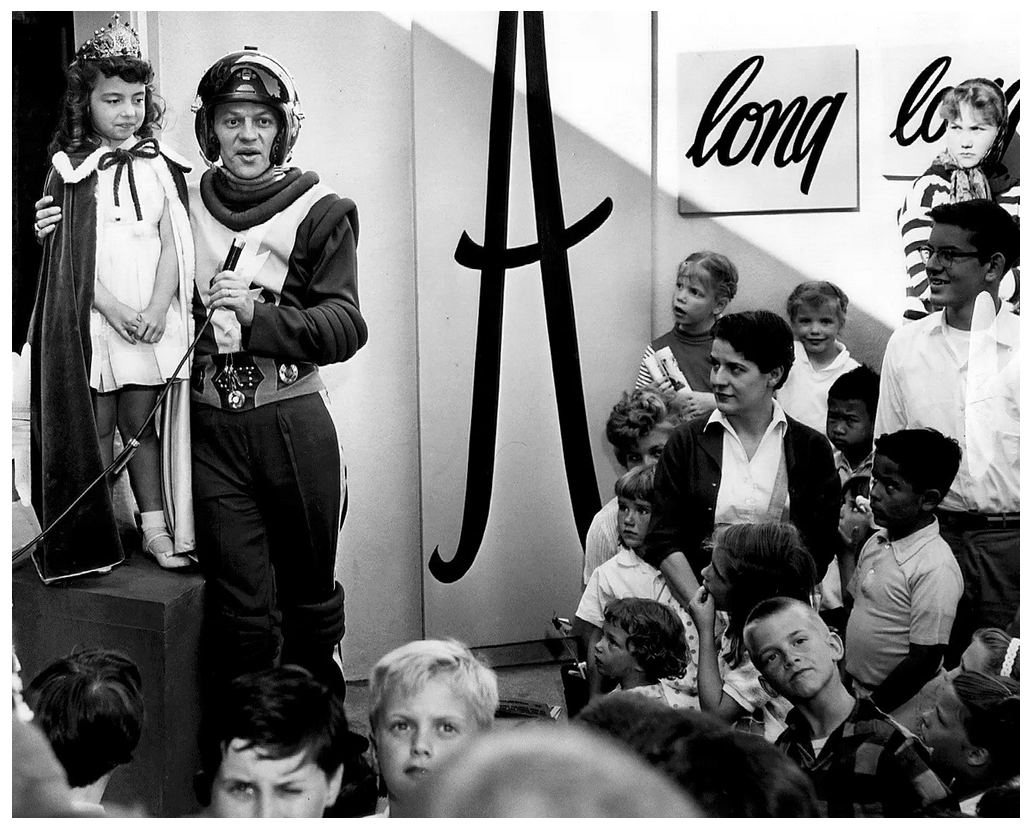
The actor’s name was Bob March. I can just imagine him meeting some other guy at a cocktail party or something:
“So, what do you do Bob?”
“I dress up in a spaceman uniform every afternoon and manage little kids on this fake rocket ship on local TV, trying to be both nice and be a captain. I’ve been doing this for 30 years now.”
“That’s great, Bob.”
Fred Rogers pulled this off. Fred was respected (especially if you watch his congressional testimony4).
Bob March comes across as emasculated, which is a very strange word. But not at the time; for a kid. Once the spell was broken, he was more of a fake like the Wizard of Oz. But as I grew up I “learned” that Miss Nancy’s comportment was appropriate just as Captain Satellite’s was not.
-
One of the last episodes on channel 2 in his new spaceship: no tilt, but lot’s of shaking! ↩︎
-
https://en.wikipedia.org/wiki/Fred_Rogers’s_1969_United_States_Senate_testimony ↩︎